Do We Need 100 Solution Architects?

In one of our previous tech podcast episodes discussing the pros and cons of using AI in our writing and coding work, Saloni brought up how software engineers were now no longer engineers, but solution architects. A friend of mine who was in the tech education industry had resonated with this shift in paradigm, but at the same time, opened up new discourse which I found interesting.
He mentioned that while he also envisioned tech education shifting in the same paradigm, where learners and graduate profiles shifted from coder to high throughput roles like solution architects and technical product managers, he couldn't help but wonder what this meant for the future of the tech industry.
In particular, he had a penultimate question that bugged him till no end that he wanted to pick my brain on. And BOY did he pick at it! He said:
You might have needed 100 coders in the past, but with this paradigm shift, we're not going to need 100 architects...
He admitted this was more of a question for economists than techies, but I found this to be an incredibly relevant question for the future of the tech industry that should be more than food for thought.
So here's my (admittedly avant-garde) take on this question!
The Truth of the Undesirable State of the Current Tech Industry
I'm a software engineer in the tech industry who has thrived from the increase in demand for coders through the years. I remember when I started programming on my own in 2016, how it wasn't a well-known skill and how family and friends around me had thought my little hobby to be a time-waster.

Then I went to college in the United States in 2017. Being in UCLA, where the internet was born and being in the same state where Silicon Valley was in, it exposed me to the marvels of tech and the tech industry. I knew of peers who had started startups, heard of friends whose classmate was the nephew of Elon Musk (who I heard, went on to work at SpaceX), inadvertently was chaffeured in a Tesla when it hadn't yet made public news. Tech was all around me, and it was only there where my programming skills flourished through leading a coding club and applying programming to everything from research to being a layout editor for a student arts publication (I made a digital magazine that I shamelessly put my own digital art on).
Truly, being a software engineer and seeing the tech industry grow and thrive was a marvellous thing.
But it was also being at the heart of it all that I realized how much power the tech industry held.
In 2019, I had a short working stint at the Chamber of Digital Commerce (now known as the Digital Chamber), which was then the world's largest blockchain trade association based in Washington DC.
Oh yea, I know what you're thinking: I guess I was considered a cryptobro? Haha 😂
In that stint, I was exposed to the power of the tech industry. I had the privilege to sit into a congressional hearing on Libra, then a cryptocurrency that Facebook, now known as Meta, had planned to launch together with 28 founding partners, which included Mastercard, Visa, eBay, and a number of other companies.
 Image from
 It was a huge deal for the US government as to policymakers, it threatened to overthrow the power of the US dollar and the power of the Federal Reserve. Facebook had also wanted to locate its headquarters in Switzerland, justifying that it was a finance hub, which to US policymakers, meant it would not be creating American jobs. More than that, it was the fear of the amount of power that this would give already poewrful tech players like Facebook - now that it could control the flow of money. Complemented with its almost absolute control ofthe flow of information through social media, that was ALOT of power vested in just a few players.
I also saw firsthand how powerless the average policymaker was due to tech illiteracy. Most of the policymakers did not have a grasp of blockchain, and could not question Mark Zuckerberg then very well. He could smartly evade most of the questions by feigning ignorance and confusion, leaving the policymakers frustrated and helpless.
I'm sure this is not the first time you've heard of this - it's the same story we're seeing over and over again - for example when Bytedance's CEO was questioned in the US Congress. Oh the number of memes that that one hearing generated!
The point I'm making, is that big tech truly is powerful. And alot of its power comes from its economic structure.
The Economics of Big Tech
The tech industry today operates as what economists call an oligopoly - a market structure dominated by a small number of large firms. And the numbers are staggering.
As of 2024, just five companies - Apple, Microsoft, Google (Alphabet), Amazon, and Meta - control over 60% of the entire U.S. tech market capitalization. Apple and Microsoft alone are worth over $3 trillion each. In search, Google commands approximately 92% of the global market share. In social media, Meta's family of apps (Facebook, Instagram, WhatsApp) reaches over 3 billion users. Amazon controls nearly 40% of U.S. e-commerce and over 30% of the cloud computing market through AWS.
This concentration of power hasn't gone unnoticed by regulators. Enter Lina Khan, who became chair of the Federal Trade Commission (FTC) in 2021 at just 32 years old. Khan made her name with her groundbreaking 2017 Yale Law Journal article "Amazon's Antitrust Paradox," which challenged traditional antitrust thinking that focused solely on consumer prices.

Under Khan's leadership, the FTC has taken an aggressive stance against big tech monopolies. The agency has sued Meta to unwind its acquisitions of Instagram and WhatsApp, blocked Microsoft's $69 billion acquisition of Activision Blizzard (though it eventually went through), and filed antitrust lawsuits against Amazon for allegedly maintaining monopoly power through anti-competitive practices.
Khan's approach recognizes that monopolies harm more than just consumer prices - they stifle innovation, reduce worker bargaining power, and concentrate economic and political power in ways that threaten democratic institutions. And she's right.
Monopolies Aren't Good for the Economy
The economic case against monopolies is well-established, yet somehow we've allowed tech giants to consolidate power in ways that would have been unthinkable in previous eras.
Research from the National Bureau of Economic Research shows that increased market concentration has led to a decline in business dynamism - fewer startups are being created, and those that are created grow more slowly. A 2019 study published in the American Economic Review found that rising market power has contributed to declining labor share of income, meaning workers are getting a smaller piece of the economic pie.
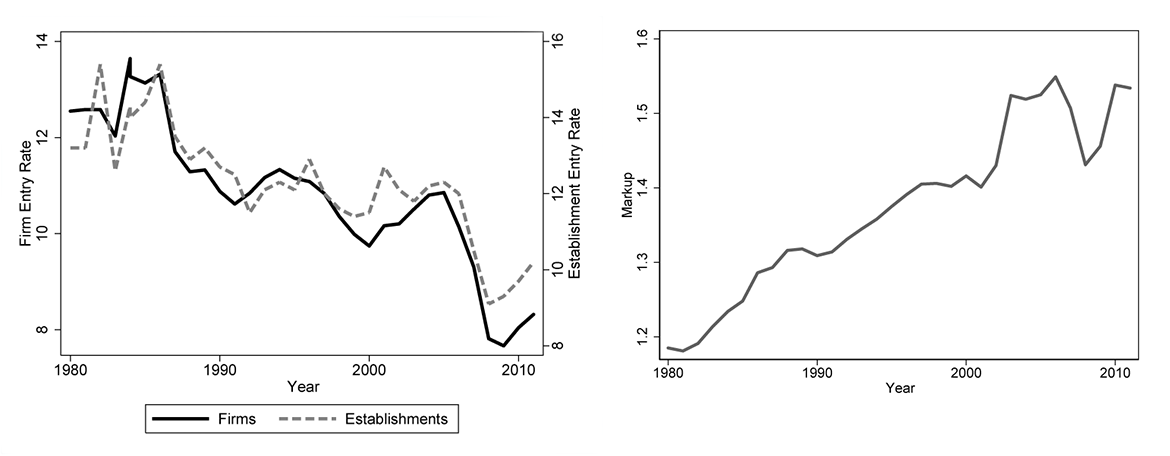 The figures show the decline in firm and establishment enry rates in the United States along with an increase in the average markup of large publicly traded firms since 1980s, suggesting a rise in the market power of large firms as business dynamism declines. Image from https://www.federalreserve.gov/econres/notes/feds-notes/what-happened-to-us-business-dynamism-20200214.html
When a few companies dominate a market, they have less incentive to innovate. Why invest in risky R&D when you can simply acquire any potential competitor before they become a threat? Facebook's acquisition of Instagram for $1 billion in 2012 and WhatsApp for $19 billion in 2014 are textbook examples of this "kill zone" strategy - buying up potential competitors before they can challenge your dominance.
Monopolies also create what economists call "deadweight loss" - economic inefficiency where potential gains from trade are not realized. When companies don't face competitive pressure, they can charge higher prices, offer lower quality, and invest less in innovation. The result is a less dynamic, less innovative economy that benefits shareholders and executives while leaving workers and consumers worse off.
Perhaps most concerning is the impact on entrepreneurship. When would-be founders know that any successful startup will either be acquired by or crushed by an incumbent, the incentive to innovate diminishes. Why take the risk of building something new when the best-case scenario is a buyout and the worst-case is being put out of business by a company with effectively unlimited resources?
The Attention Economy and How We're Being Manipulated
In the attention economy, you're not the customer - you're the product. And when monopolies control the platforms where we spend our time, the consequences go far beyond economics.
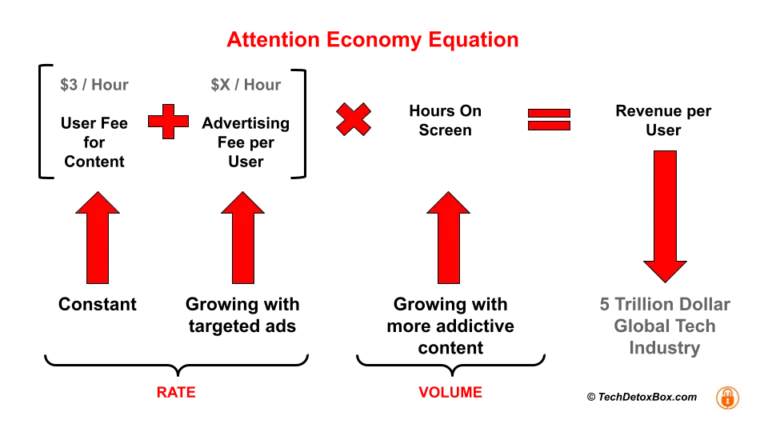 Image from https://www.techdetoxbox.com/weapons-of-digital-manipulation/how-attention-economy-works/
Meta, Google, and TikTok don't charge users money because they've found something far more valuable: our attention. These platforms have become extraordinarily sophisticated at capturing and monetizing every second we spend scrolling, watching, and clicking. The average person spends over 2.5 hours per day on social media, and that's not by accident - it's by design.
These companies employ teams of psychologists, neuroscientists, and behavioral economists to make their products as addictive as possible. Features like infinite scroll, push notifications, and algorithmic feeds that show us increasingly extreme content are all designed to maximize "engagement" - a sanitized term for keeping us hooked.
But here's where the monopoly aspect becomes critical: when there are no real alternatives, we can't vote with our feet. Sure, you could delete Instagram, but where will you go? All your friends are there. Your favorite creators post there. Events are organized there. The network effects that made these platforms successful in the first place now trap us in them.
The cost to consumers isn't just measured in time wasted or mental health impacts (though those are significant). It's also in the erosion of privacy, the manipulation of our political discourse, and the commodification of our most intimate moments. When a handful of companies control the primary channels through which we communicate, learn, and form opinions, they wield unprecedented power over society itself.
And because these platforms operate as monopolies, they face little pressure to change. Where else are you going to go?
The Impact on Children: A Crisis We Can't Ignore

If the attention economy is harmful for adults, it's catastrophic for children. Jonathan Haidt's book "The Anxious Generation" documents how the rise of smartphone-based childhood has coincided with an unprecedented mental health crisis among young people. Between 2010 and 2019, rates of depression among adolescents increased by 145% for girls and 161% for boys. Anxiety, self-harm, and suicide rates have all spiked in tandem with social media adoption.

But what makes it more sinister is that these companies know exactly what they're doing.
In 2021, whistleblower Frances Haugen, an ex-product manager at Meta, leaked internal Meta documents revealing that the company had conducted extensive research into Instagram's effects on teenage girls. The research found that 32% of teen girls said that when they felt bad about their bodies, Instagram made them feel worse. One internal presentation stated: "We make body image issues worse for one in three teen girls."
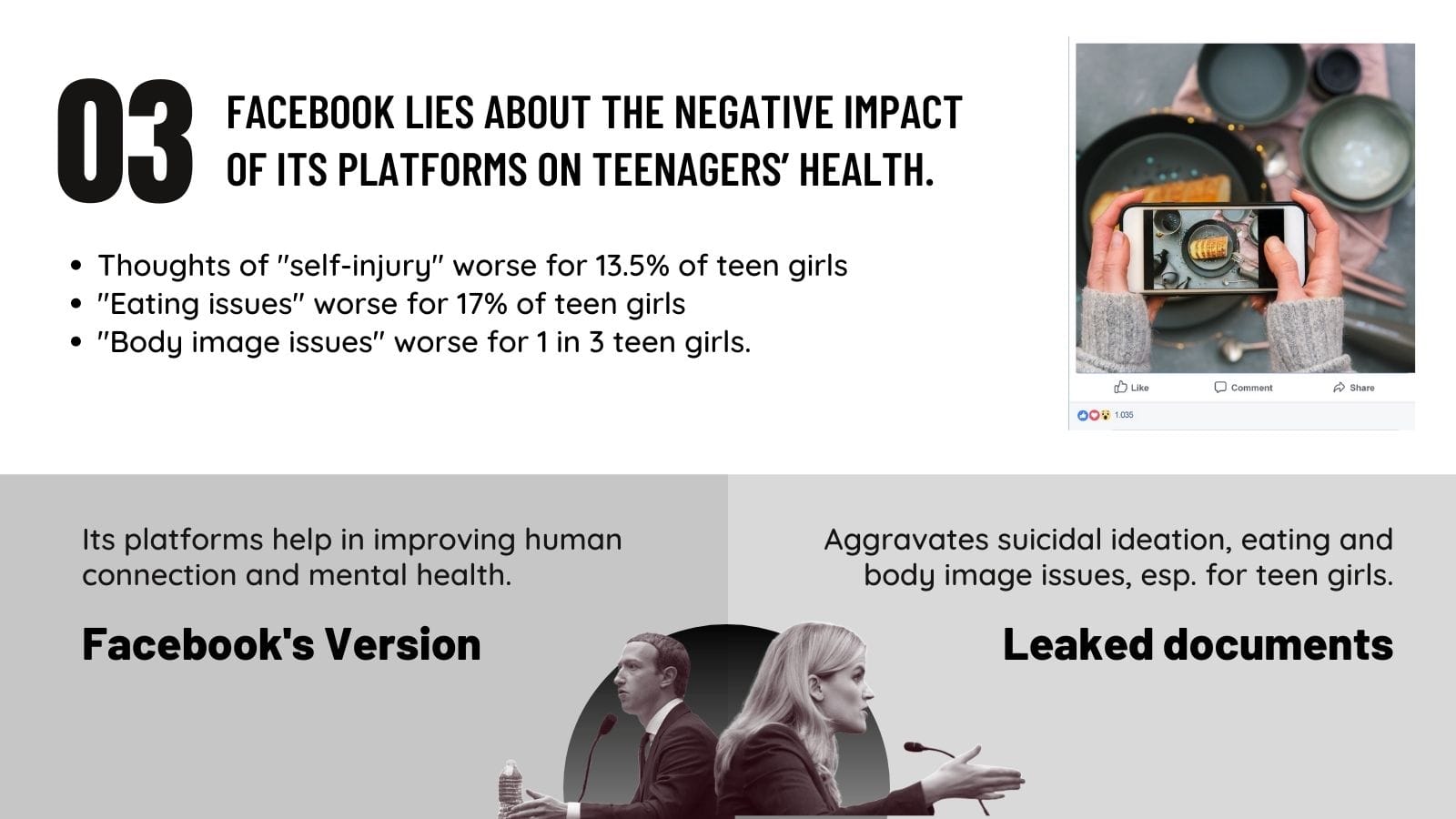
But this wasn't framed as a study to fix the platform. According to the leaked documents, Meta used this research to create detailed user personas of vulnerable teenage girls - understanding their insecurities, their triggers, their patterns of use. The goal wasn't to protect these kids; it was to amplify the features that kept them hooked, creating a vicious cycle where anxiety drove more usage, which drove more anxiety, which drove more usage.
They knew the product was harmful. They studied exactly how it was harmful. And then they used that knowledge to make it more addictive.
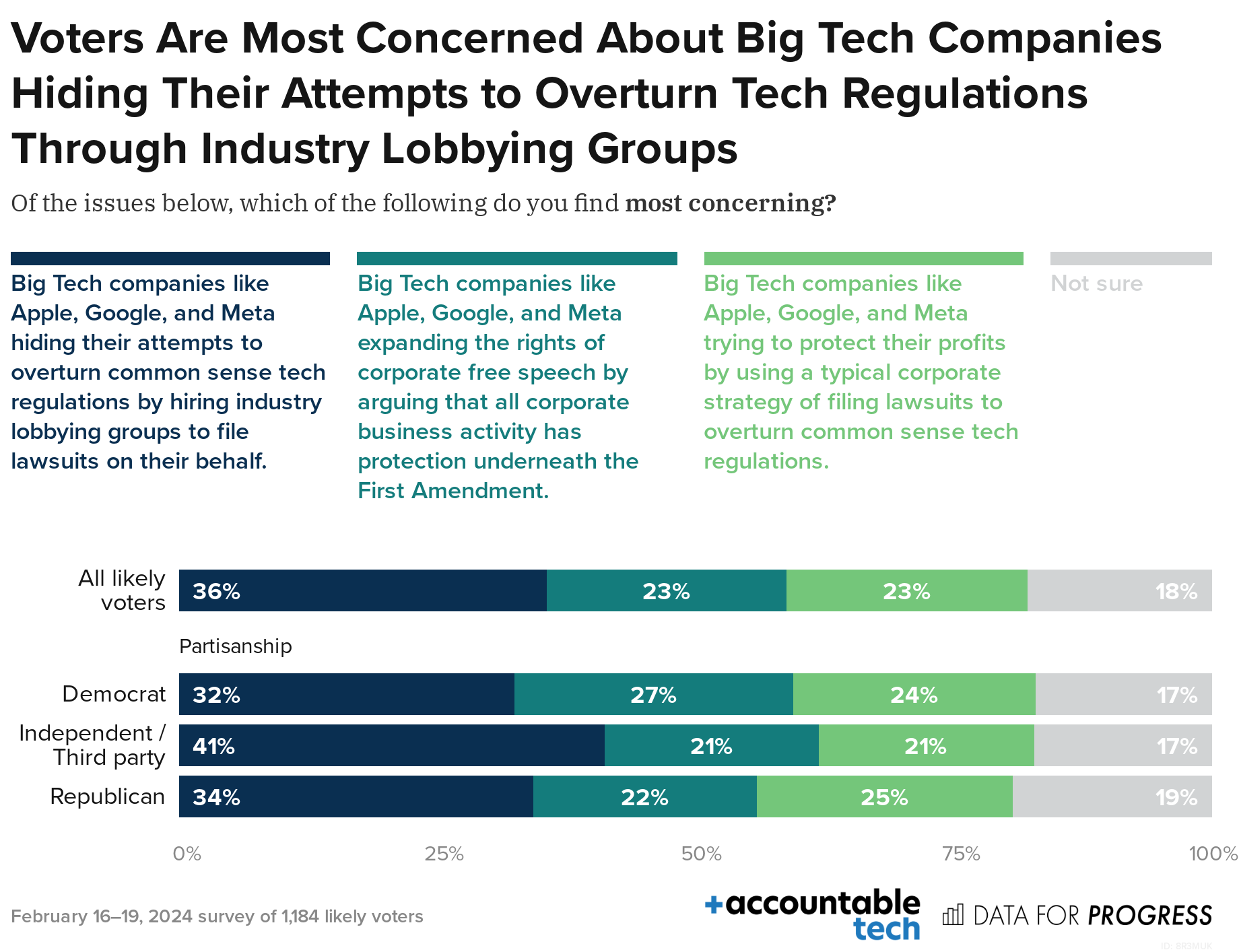
And yet, despite whistleblowers, despite congressional hearings, despite mounting evidence of harm, we haven't been able to create meaningful regulations for these companies. Why? Because they have too much vested power. They employ armies of lobbyists. They fund think tanks and research institutions. They make strategic political donations. They've become too big to regulate.
When a handful of companies control the platforms where billions of people - including our children - spend their time, and when those companies prioritize engagement and profit over wellbeing, we have a crisis. And when those same companies have accumulated so much political and economic power that they're effectively immune to regulation, we have a system that's fundamentally broken.
The Hiring Power of Big Tech
Big tech companies don't just dominate markets - they dominate talent pools. And this creates a vicious cycle that further entrenches their power while starving the rest of the economy of innovation.
The numbers tell the truth (which you already know): Google, Meta, Amazon, Apple, and Microsoft collectively employ over 1.5 million people globally. But it's not just the quantity - it's the quality. These companies can offer compensation packages that smaller companies and startups simply cannot match. Total compensation for senior engineers at these companies can easily exceed $500,000 per year when you include base salary, bonuses, and stock options.
Brookings analysis shows U.S. tech growth remains heavily concentrated in a small number of dominant hubs, reinforcing winner-take-most talent dynamics. And CSET's "The Race for U.S. Technical Talent" reports that more than 60% of technical workers in Big Tech firms held degrees from "ranked" universities (compared with roughly 20% in the DoD sample they studied). This concentration dynamic leaves startups and smaller companies struggling to compete for top talent.
Unfortunately, much of this talent isn't being used to create innovative new products or solve hard problems. Instead, they're working on incremental improvements to existing products, building internal tools, or - and this is crucial - simply being kept away from competitors.
 Thumbnail Image from Youtube Video: https://www.youtube.com/watch?v=h24I2Rrjqmc
Economists call this "defensive hiring" or "talent hoarding." Companies hire brilliant engineers not because they have meaningful work for them, but to prevent competitors from hiring them. It's a rational strategy for the individual company, but it's economically wasteful for society as a whole.
The impact on the broader economy is significant. When the best and brightest are concentrated in a handful of companies, innovation in other sectors suffers. We end up with incredibly sophisticated algorithms for serving ads and keeping people scrolling, but slower progress in areas like healthcare, education, and climate tech where talent is desperately needed but can't compete on compensation.
Big Tech Doesn't Need to Be... That Big
Most big tech companies are bloated beyond any reasonable operational need. And the recent waves of layoffs have proven it.
People blame AI for the layoffs, but it's not AI's fault. It's the fault of the companies that hired so many people in the first place (especially during COVID!). What's happening is a market correction.
In 2022 and 2023, tech companies laid off over 400,000 workers. Meta cut 21,000 jobs. Amazon laid off 27,000. Google cut 12,000. Microsoft eliminated 10,000 positions. And you know what happened to these companies after the layoffs? Their stock prices went up. Their products continued to function. In many cases, employees reported that things actually got better - fewer meetings, less bureaucracy, faster decision-making.
 Image from https://www.statista.com/chart/29175/largest-tech-layoffs-since-2020/
So why were all these people hired in the first place?
For many companies, especially unicorn startups, hiring is a signal to investors. Headcount growth is seen as a proxy for company growth. "We're scaling!" they announce, as they hire hundreds of engineers. Never mind that revenue hasn't materialized or that the product-market fit is questionable. The appearance of growth is what matters for the next funding round.
But there's a more insidious reason for bloat: coordination overhead. As companies grow, they need more people just to coordinate the people they already have. You need program managers to coordinate between teams. You need product managers to translate between engineering and business. You need engineering managers to manage the managers. You need directors to manage the managers of managers.
Then there are roles that exist purely because of organizational complexity. Release managers who coordinate deployments across dozens of teams. Developer experience engineers who build tools to help other engineers navigate the company's labyrinthine systems. Technical program managers who spend their days in meetings trying to align different teams' roadmaps.
None of this is the fault of the individuals in these roles - they're doing necessary work. But it's only necessary because the organization has become so large and complex that it can barely function. It's like a snake eating its own tail.
The irony is that many of the most impactful products in tech were built by tiny teams. WhatsApp had 55 employees when it was acquired for $19 billion. Instagram had 13 employees when it was acquired for $1 billion. These weren't just lucky flukes - they demonstrate that with the right focus and tools, small teams can build products that serve billions of users.
The bloat isn't a bug - it's a feature of monopolistic companies that have more money than they know what to do with and need to appear to be "investing in growth" to satisfy shareholders.
Big Tech No Longer Solves a Specific Problem
When was the last time you could describe what a big tech company does in a single sentence? It's become nearly impossible.
Take Grab, the Southeast Asian super-app and Singapore's precious gem (which ironically, was built by Malaysians who chanced upon Uber and decided to build a Southeast Asian version... btw no hate to Malaysians I'm basically part-Malaysian too! Just pointing another funny fact). It started as a ride-hailing service - a clear, focused problem. But now? It's ride-hailing, food delivery, grocery delivery, package delivery, digital payments, financial services, insurance, hotel bookings, and more. Open the app and you're confronted with a dizzying array of options that have nothing to do with getting from point A to point B.
 Image from
 Or look at Meta. Facebook started as a way to connect with college classmates. Now it's social networking, messaging, photo sharing, video streaming, virtual reality, augmented reality, artificial intelligence research, cryptocurrency (remember I mentioned Libra?), e-commerce, and whatever the metaverse is supposed to be. Mark Zuckerberg has spent over $36 billion on VR and metaverse initiatives that have yet to find product-market fit, all while the core social media products stagnate.
Google is a search engine, an email provider, a cloud computing platform, a smartphone manufacturer, a self-driving car company, an AI research lab, a video streaming platform, a productivity suite, a smart home device maker, and a health tech company. Amazon sells books - oh wait, no, it sells everything, and also runs half the internet's infrastructure, makes movies and TV shows, owns a grocery chain, manufactures smart speakers, and is getting into healthcare.
This sprawl isn't efficient - it's the opposite. When a company tries to do everything, it does nothing particularly well. Resources get spread thin. Focus is lost. Internal politics determine which projects get funding rather than market need or innovation potential.
More importantly, this "do everything" approach is only possible because these companies have monopoly profits from their core businesses that they can use to subsidize expansion into other markets. They can afford to lose money for years in new ventures because they're printing money in their monopoly markets. This makes it nearly impossible for focused startups to compete.
A startup that wants to build a better food delivery service has to compete with Grab, which can subsidize its food delivery with profits from ride-hailing. A company building VR hardware has to compete with Meta, which can lose billions on VR while still making tens of billions from advertising.
The result is less innovation, less competition, and worse products for consumers. We'd be better off with ten focused companies each solving one problem really well than one company trying to solve ten problems poorly.
My Vision for the Future of Tech with AI
So here's where we circle back to my friend's question: if we don't need 100 coders anymore, do we need 100 solution architects?
My answer is: not if they're all working for the same bloated company. But yes, absolutely, if they're working for 100 different focused companies.
:no_upscale()/cdn.vox-cdn.com/uploads/chorus_asset/file/19211157/obJoP_breaking_up_big_tech_future_competition_2_.png) Image from
Image from AI is fundamentally changing the economics of software development. With tools like GitHub Copilot, ChatGPT, and Claude, a single skilled engineer can now do the work that previously required a team. The bottleneck is no longer writing code - it's knowing what to build and how to architect it.
This shift actually makes the case for breaking up big tech even stronger.
In the old model, you needed large teams because building software was labor-intensive. The coordination overhead was worth it because you needed those 100 engineers. But now, with AI augmentation, you might only need 10 engineers to build the same product. Suddenly, the coordination overhead of a large organization becomes a liability rather than a necessity.
Imagine if instead of one Meta with 67,000 employees trying to do social media, messaging, VR, AR, and AI, we had:
- A focused social networking company with 500 employees
- A messaging company with 200 employees
- A VR company with 300 employees
- An AR company with 300 employees
- Multiple AI research companies, each with 100-200 employees
Each of these companies would need solution architects. Each would need technical leaders who can see the big picture, make architectural decisions, and guide AI-augmented developers. But they'd be lean, focused, and actually solving specific problems rather than drowning in coordination overhead.
The total number of people employed might be lower, yes. But the output would be higher, the innovation would be faster, and the products would be better. And here's the key: those solution architects would have real ownership and impact rather than being cogs in a massive machine.
This isn't just theoretical - we're already seeing it happen. The most exciting products in tech today are being built by small teams using AI tools. Midjourney, one of the leading AI image generation companies, has fewer than 40 employees. Many successful AI startups have teams of 10-20 people building products that compete with offerings from companies with thousands of engineers.
The future of tech isn't 100 architects at one company. It's 100 companies, each with their own architects, each focused on solving one problem really well.
What Does This Mean for Software Engineers?
If you're a software engineer reading this, you might be feeling anxious. "Should I be worried about my job?" The answer is: maybe, if you're planning to stay on the traditional path. But you should be excited if you're willing to think differently.
The shift to AI-augmented development doesn't just mean becoming a solution architect - though that's part of it. It means becoming a product person. An entrepreneur. A builder who captures value directly rather than trading time for money at a big company.
Here's the thing: you now have superpowers that previous generations of engineers could only dream of. With AI tools, you can:
- Build a full-stack application in days that would have taken months
- Design and implement complex systems without a team
- Create beautiful UIs without being a designer
- Write marketing copy without being a copywriter
- Analyze data without being a data scientist
You have all the skills you need to build a product on your own. More importantly, you can now capture value directly from that product rather than building someone else's product and getting a salary while they get rich.
Think about it: in the old model, you'd join a startup, work 80-hour weeks, get paid $150k and some equity that might be worth something someday. The founders and early investors capture most of the value. You're trading your labor for a small slice of the pie.
In the new model, you can build your own product in your spare time, launch it, and capture 100% of the value. You don't need venture capital to hire a team. You don't need to give up equity to co-founders. You can stay lean, stay focused, and build something profitable.
This doesn't mean everyone should quit their job and become a solo founder. But it does mean that the risk-reward calculation has fundamentally changed. The risk of starting something is lower (you can build an MVP in weeks, not months). The potential reward is higher (you own it all). And the opportunity cost is lower (you can do it on the side while keeping your job).
We talk about our perspectives on non-technical founders and what techies can learn from them here!
The engineers who thrive in this new era won't be the ones who are best at writing code - AI is getting better at that every day. They'll be the ones who can:
- Identify real problems worth solving
- Design elegant solutions
- Make smart architectural decisions
- Understand users and markets
- Ship products and iterate quickly
In other words, they'll be product engineers. Solution architects. Technical founders. Not just code monkeys making someone else rich.
Good for Consumers
This shift isn't just good for engineers - it's great for consumers too.
Instead of being forced to use bloated super-apps that try to do everything, we'll have options. Real options. Niche products that do one thing exceptionally well.
:max_bytes(150000):strip_icc()/monopolistic-market-4192732-2-1a0a84322d2041c4b72d5ea41b836147.jpg) Image from https://animalia-life.club/qa/pictures/monopolistic-competition-vs-monopoly
Image from https://animalia-life.club/qa/pictures/monopolistic-competition-vs-monopoly
Want a messaging app? You'll have dozens to choose from, each with different features, privacy models, and design philosophies. Not just WhatsApp, Messenger, and iMessage - all of which are controlled by trillion-dollar companies with their own agendas.
Want a ride-hailing service? You'll have options beyond just Uber and Lyft in US and Grab in Singapore. Maybe one that treats drivers better. Maybe one that's cheaper because it's not subsidizing a dozen other business lines. Maybe one that's focused on sustainability.
Want a social network? You'll have alternatives to Facebook and Instagram that aren't designed to maximize your engagement at the cost of your mental health. Maybe one that's ad-free and subscription-based. Maybe one that's focused on your local community. Maybe one that's built around a specific interest or hobby.
This is already starting to happen. Look at the explosion of niche software products:
- Linear for issue tracking (instead of bloated Jira)
- Notion for notes (instead of trying to use Google Docs for everything. But then again Notion is getting big too)
- Superhuman for email (instead of Gmail)
- Arc for browsing (instead of Chrome)
- Raycast for productivity (instead of Spotlight)
These products are built by small teams, focused on doing one thing really well, and they're winning customers from the big tech incumbents. They're not trying to be everything to everyone. They're trying to be the best at one specific thing for a specific audience.
As AI makes it easier to build software, we'll see an explosion of these focused products. Competition will increase. Innovation will accelerate. And consumers will benefit from having real choices rather than being locked into whatever the monopoly offers.
The future of tech isn't one app that does everything. It's a thousand apps, each doing one thing beautifully.
Current Trends I'm Seeing
This isn't just theoretical speculation - I'm seeing this shift happen in real-time among my peers in the tech industry.
Many of my software engineer friends are starting their own companies. Not venture-backed startups with grand ambitions to become the next unicorn, but sustainable, profitable businesses that solve real problems. They're building SaaS products, development tools, niche marketplaces, and specialized services. They're staying small, staying lean, and staying focused.

We saw this firsthand at a local startup pitch night where many teams were actively building, iterating, and searching for stronger technical leadership. I wrote more about those observations in Why Finding a CTO is Harder Than You Think.
What's particularly interesting is what's happening with engineers who've been laid off. In previous downturns, laid-off engineers would immediately start applying to other big tech companies. But this time, many are choosing a different path. They're taking their severance packages and using them as runway to build their own products.
Sure, they might take a pay cut, but they also eliminated the stress of corporate politics, the frustration of working on projects that get cancelled, and the feeling of being a replaceable cog in a massive machine.
I'm also seeing a shift in what new graduates want. The prestige of working at FAANG companies is fading. More and more talented engineers are choosing to join small startups or start their own projects rather than grinding through LeetCode problems to get a job at Google.
The tools are enabling this shift. GitHub Copilot, ChatGPT, Claude, Cursor, and other AI coding assistants are making it possible for individual developers to be incredibly productive. No-code and low-code tools are making it easier to build MVPs quickly. Distribution platforms like Product Hunt, Twitter, and Reddit make it possible to reach customers without a marketing team.
Watch our episode on our honest take on vibe coding!
The economics are enabling it too. Cloud infrastructure is cheap. You can build and deploy a product for $20/month. You don't need office space. You don't need to hire a team. You can start small, validate the idea, and scale only if it works.
Most importantly, the mindset is shifting. Engineers are realizing that they don't need permission to build things. They don't need to wait for a company to hire them or a VC to fund them. They can just build.
This is the future I'm excited about. Not one where we need 100 architects at one company, but one where we have 100 companies, each built by engineers who saw a problem and decided to solve it themselves. That's the future where we don't need big tech to be so big - because we'll have thousands of small, focused companies building great products.
The Missing Gaps that Government and Education Need to Fill
But here's where I need to call out a critical blind spot: governments and education institutions are completely missing the point.
Governments around the world are pouring billions into "AI initiatives" and "digital transformation." Singapore has its National AI Strategy. The EU has its AI Act. The U.S. is throwing money at AI research. But they're all focused on the wrong thing - they're investing in AI as a technology, not in AI as an enabler of economic transformation.
What we actually need is infrastructure to enable people to found companies. More startup grants, yes, but more importantly: lower barriers to entry. Simplify business registration. Reduce regulatory overhead for small businesses. Make it easier to hire and fire (controversial, I know, but crucial for small companies). Provide tax incentives for solo founders and micro-businesses, not just for companies that can afford armies of accountants to navigate complex tax codes.
 Image from https://www.singaporecompanyincorporation.sg/blog/13-startup-schemes-and-grants-in-singapore/
Instead, we're making it harder. Want to start a company in most countries? Prepare for months of paperwork, minimum capital requirements, complex tax filings, and regulations designed for enterprises with legal departments. It's absurd that it's easier to build a product that serves millions of users than it is to legally register the business that sells it.
Education institutions are equally guilty of missing the trend. Universities and bootcamps are rushing to introduce AI tools into their curriculums - "Look, we teach with ChatGPT now!" - without fundamentally rethinking what students need to learn.
We don't need to teach students how to write code anymore - AI can do that. We need to teach them how to build products. How to identify problems worth solving. How to talk to users. How to design solutions. How to make architectural decisions. How to ship and iterate. How to market and sell. How to run a sustainable business.
In other words, we need to teach entrepreneurship as a core skill, not as an elective that only business students take. Every computer science student should graduate knowing not just how to code, but how to take an idea from concept to paying customers.
And please, for the love of all that is good, we need to teach ethics.
 Image from https://healthcarereimagined.net/2021/05/16/big-techs-guide-to-talking-about-ai-ethics/
The Meta researchers who designed features to exploit teenage girls' insecurities? They were trained at top universities. The engineers who built addictive algorithms that prioritize engagement over wellbeing? They learned their craft in our education system. The executives who chose monopolistic practices over fair competition? They're products of our business schools.
We've created a generation of technically brilliant people who never stopped to ask: "Should we build this? What are the consequences? Who gets hurt?"
Ethics shouldn't be a single course you take in first year and forget about. It should be woven into every project, every assignment, every discussion. When you're teaching students to build a social media app, also teach them about addiction, mental health, and platform responsibility. When you're teaching machine learning, also teach them about bias, fairness, and accountability. When you're teaching business strategy, also teach them about stakeholder capitalism and long-term thinking.
The future we're building - one with thousands of small, focused companies - only works if the people building those companies have a moral compass. Otherwise, we'll just end up with a thousand small companies doing unethical things instead of a few big ones.
Governments and education institutions have a crucial role to play in this transition. But they need to stop chasing the shiny object of "AI" and start addressing the fundamental shifts in how value is created and captured in the economy. They need to enable entrepreneurship, teach product thinking, and instill ethics.
Because the tools are already here. The economics are already shifting. The only question is whether our institutions will catch up in time to guide this transformation in a positive direction, or whether they'll keep fighting yesterday's battles while the world moves on without them.